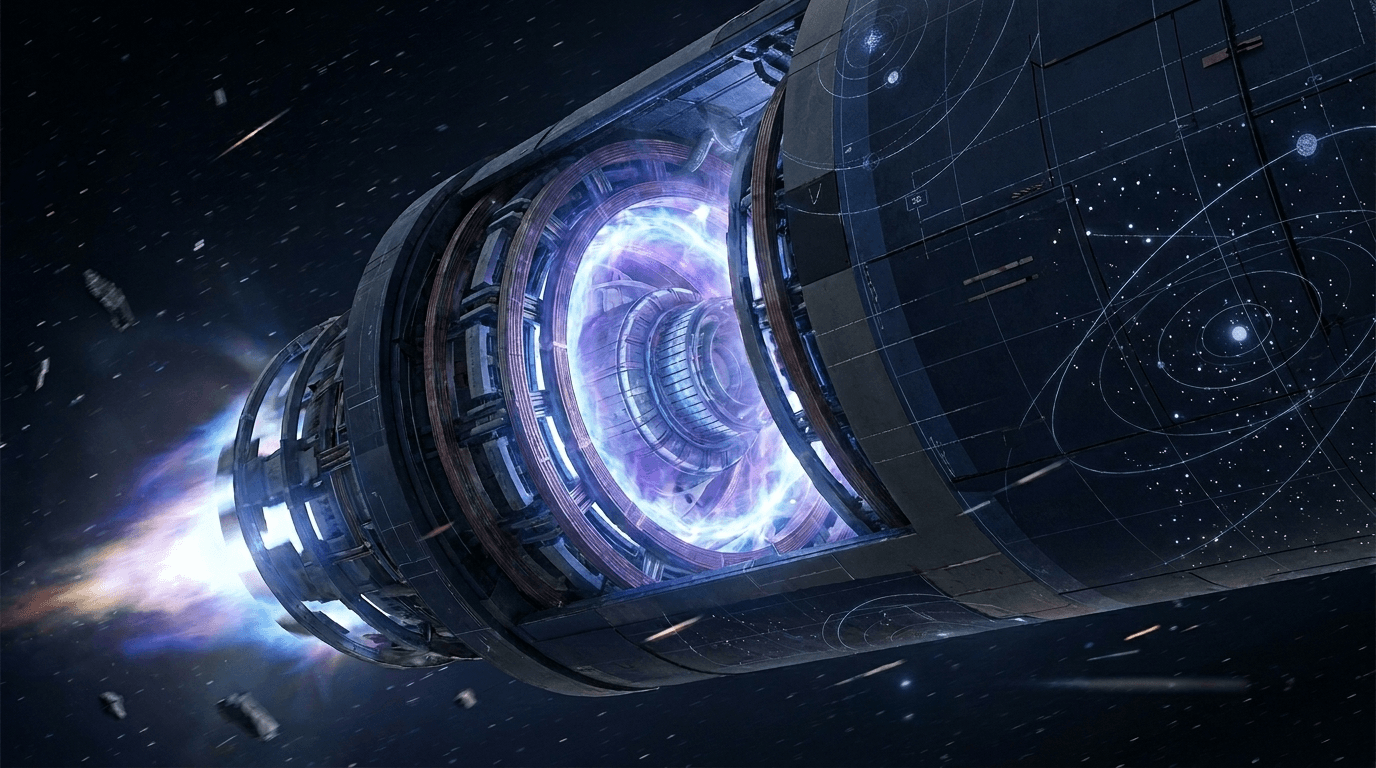
Deep-space propulsion
200 km/s is a meaningful velocity threshold for solar-system civilization
Solar-system freedom does not need to begin with one percent of light speed.
Live visual layer
Deep-space propulsion / long-horizon research and engineering vision.
Module 01
Velocity threshold
Why 100-200 km/s matters
Why 100-200 km/s matters
Module 02
Mission scenarios
Lunar bases, Mars transport, asteroid belt, and deep-space engineering
Lunar bases, Mars transport, asteroid belt, and deep-space engineering
Module 03
Independent path
Terrestrial fusion plants are not space fusion engines
Terrestrial fusion plants are not space fusion engines
Mission narrative
Why 100-200 km/s is already a meaningful threshold for solar-system civilization
The target is not written as 1% light speed because a great deal of solar-system transport, engineering, and base-support work changes character well below that level.
Velocity threshold
Solve solar-system scale first, then talk about farther relativistic stories
Why 100-200 km/s matters
The 100-200 km/s range already changes the tempo of Mars transit, asteroid-belt supply, lunar-base logistics, and deep-space robotic work. That makes it a more meaningful engineering threshold for this roadmap.
Mission scenarios
Lunar, Martian, asteroid, and deep-space work all need a durable transport layer
Lunar bases, Mars transport, asteroid belt, and deep-space engineering
Solar-system freedom is not a single landing event. It is repeated transport, maintenance, assembly, supply, and return capability. Velocity thresholds determine whether that network becomes routine.
Independent path
A terrestrial fusion plant is not a space fusion engine
Terrestrial fusion plants are not space fusion engines
Space propulsion must also solve mass, thermal control, radiation, orbital assembly, nozzle design, and life-support constraints. It needs its own aerospace path rather than a direct translation of ground power systems.